
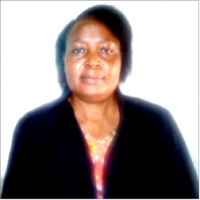
Student Short Biography:
Khaitsa Susan Wasubire was born in 1966 to the Late Mr. Elidad Nephew Wasubire and Mrs. Luki Phyllis Wasubire, the 3rd born in a family of 14 children. She was raised in Mbale, Eastern Uganda at the foothills of Mt. Elgon. As a lover of nature and its vast resources, she observed the significant changes in her immediate environment of the Mt. Elgon Region. She took a very keen interest in the changing natural aspects of the natural environment where ever she went. This prompted a desire to investigate the causes, hence the pursuit of a masters in the science of climate change.
While pursuing Bachelor of Arts degree in Democracy and Development Studies with Uganda Martyrs University, Susan pursued a Diploma in Community Based Adaptation to Climate Change with the Center for Sustainable Development (CSD-i) CA, USA. Susan was sponsored by Deutscher Akademischer Austauschdienst (DAAD) for a cetificate in Environmental and Remote Sensing Data Analysis via Geospatial Technologies in Research and Teaching with Goethe-University of Frankfrut am Main/Phillipps University, Marburg, Germany. DAAD also sponsored her for a Master of Science in Climate Change with the University of Nairobi under the department of Meteorology where she attained amongst others exceptional skills and experience in Research, Climate Change Mitigation and Adaptation, Modelling and Simulation for Climate Change.
She worked under ICSEA under Uganda Carbon Bureau as a Carbon Finance Specialist and as a Researcher with GAPLINK a Ugandan research and development organization. Currently Susan is working with Vision Multiple Services an organization promoting human sustainable development that creates self-reliant communities.
Project Summary
Thesis / Project Title: Investigating Socio-Economic Impacts Of Sustainable Mountain Freshwater Ecosystem Services In Mt. Elgon Watersheds Under A Changing Climate
Thesis / Project Abstract:
The Mt. Elgon watersheds are important freshwater catchment for rivers that provide water for all aspects of human livelihoods in the region. The increasing socio-economic drivers of climate change are impacting mountain freshwater ecosystem service provision in the watersheds. These have not been fully addressed, whereas degradation continues unchecked.
This study focused on investigating the socio-economic impacts of sustainable mountain freshwater ecosystem services in Mt.Elgon watersheds under a changing climate. The study used quantitative and qualitative data collecting tools. Livelihood was the independent variable, freshwater ecosystem services as the extraneous variable and climate change as the dependent variable, classified based on the view point of causation, stressing man’s role and responsibility.
Both primary and secondary data was collected. An intensive systematic evaluation of literature review on anthropogenic impacts on mountain freshwater ecosystem services was carried out to focus study, when carrying out unstructured interviews during field visits. Historical climate data for precipitation and discharge for the period 1960-2016 and 1948-2016, obtained from meteorological and water resources management government agencies of Kenya and Uganda was analysed for trend. Data for simulation modelling for opportunity cost and climate change impacts was provided with ecoengine model.
Results from the study showed climate variability depicting upward and downward trends for climate and discharge data. Results depicted increasing population rates, demand for land for livelihood activities which has led to increased demand for freshwater ecosystem services. Potential impacts projected showed that with continued poor ecosystem and freshwater ecosystems management, freshwater ecosystem services are likely to be depleted affecting their sustainability. Results of the study confirmed that socio-economic activities are impacting sustainable mountain freshwater ecosystem services in the Mt. Elgon watersheds. These will inform decision making for policy development, economic planning, enhance environmental quality, hazard mitigation and conservation for sustainable freshwater resources and services.